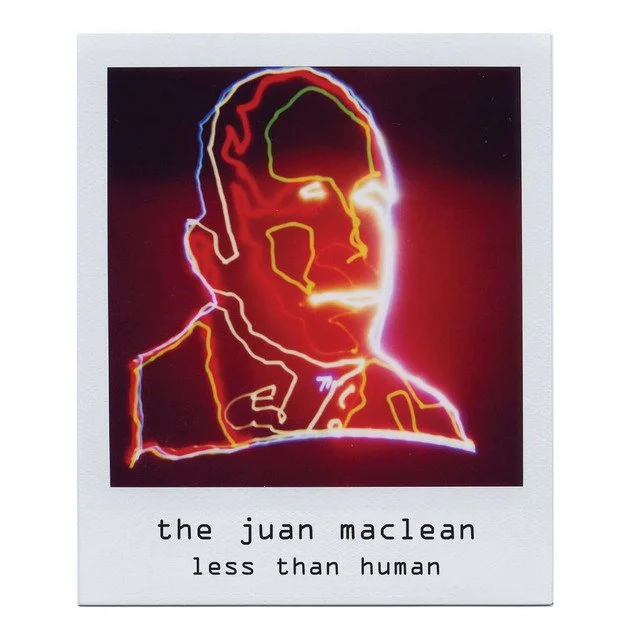
Following on from my recent post about the BlackPlastic hosted club on Sound Club, I wanted to share the write-up that accompanies the current album I'm featuring there. That album is the Juan Maclean's Less Than Human. Check out my write-up below, and head over to Sound Club to listen to the album and join in any discussion.
Coming out relatively early on in a run of what was arguably a golden era for DFA Records, John Maclean’s The Juan Maclean project saw him team up with LCD Soundsystem’s Nancy Whang. Together they have created multiple albums blending elements of house, techno, and electro.
None resonate for me quite like this first album, Less Than Human. Whilst it comprises just nine songs, making up less than fifty-minutes of music, this is an album that occasionally reaches epic proportions. More on that later.
AD2003 is a futurist piece of electronica, synths crash and crisp drums clash on this short intro. Shining Skinned Friend is a fuller illustration of what is to come, however - post-punk influenced drums clatter, deadpan vocals creating a robotic atmosphere, against which Whang’s whispers provide hints of humanity. It is a series layered synths that really provide the song its melodic anchor however, tones weaving amongst soft pads to create a complex, mechanical combination of sounds.
Every Little Thing opens with a clear blue stuttering synth, feeling like we are floating in space. And then Maclean drops a funky as hell bass line - conjuring a retro futurist sound that simultaneously sounds like it is from 1977, and 2037. Tito’s Way is a cacophony of noise - closer to the sort of thing label head James Murphy is known for. Drums collapse into one another, combining with a taut bassline to create a kind of stressful tension.
In my view it is here where the album drops down a gear, before coming back with the softly sanded corners of Crush The Liberation’s synths, a kind of heavenly zero attack melody, that take us back into orbit.
It is the closer, however, that acts as both the album’s, and Maclean’s career, highlight. At 14-minutes long, it represents almost a third of the entire album. Whenever I rave about this song I find many are left feeling cold by it, but there is a subtle beauty to what Maclean and Whang created. The whole album is an experiment in blending humanity with robotics - something that feels even more relevant in our age of AI than it did on release. Maclean’s synths squeak and shuffle, a series of building tones that swirl amongst themselves, exhibiting enough randomness to feel like a synthetic approximation of humanity. It is the combination of Whang, and a series of melodies from a distant piano, that anchor the song. Like a love letter between robot and person, Whang’s vocal gradually shifts from a spoken deadpan deliver to something more vulnerable and human.
“Yeah, there’s something I’ve got to tell you… hey, but I don’t know what to say,” she says, before gradually shifting to sing, “come on over, and dance with me.” It’s like a machine developing consciousness and desire, and altogether it represents an experimental piece of electronic music that is, in and of itself, a commentary on how electronic music contains deep humanity. And in the background is that piano - human, imperfect, yet beautiful.